 blog
blog
Best Coffee Roasting Beans: A 2026 Buyer's Guide
Table of Contents
- What Makes a Bean Worth Roasting
- How to Roast Coffee Beans at Home
- The Best Coffee Roasting Machine for Your Kitchen
- Coffee Bean Roast Levels Guide
- Single Origin vs. Blends for Roasting
- Bean Selection by Brewing Method
- Sustainability and Sourcing Transparency
- Troubleshooting Extraction by Bean Type
- Frequently Asked Questions
Last Updated: September 18, 2026
What Makes a Bean Worth Roasting
Not every green coffee bean deserves your roaster. The best coffee roasting beans share three traits: high density, low moisture content, and a recent harvest date. Get those right, and everything else falls into place.
Density matters because it determines how heat moves through the bean. Dense beans roast evenly and develop complex flavor. Soft beans scorch on the outside before the inside is done. Specialty Coffee Association green grading standards outlines how density and moisture are measured during quality assessment.
Here's what most home roasters miss: you can't fix a bad green bean with good technique. Starting with quality green coffee is the whole game.
Density, Moisture, and Why They Decide Everything
Bean density is measured in grams per liter, and higher numbers generally mean better roasting potential. High-grown arabica beans from elevations above 1,200 meters tend to be denser than lower-grown varieties.
Moisture content should fall between 10 and 12 percent for optimal roasting. Too dry, and beans roast flat. Too wet, and you get uneven development and potential mold issues.
Ask your supplier for these numbers before buying. A reputable green coffee seller will have them on hand.
How to Roast Coffee Beans at Home
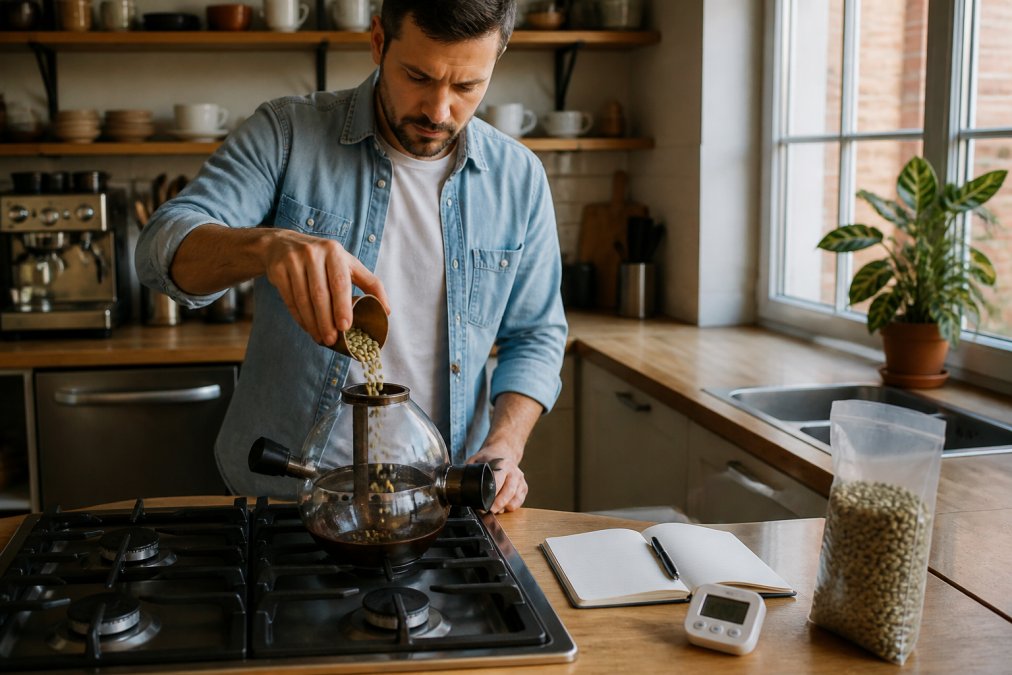
Learning how to roast coffee beans at home takes about 15 minutes per batch once you know what you're doing. The learning curve is real, but it's shorter than most people expect.
Start with a small batch, around 100 grams. You'll make mistakes, and small batches waste less coffee.
Pan, Oven, and Air Popper Methods Compared
Three entry-level methods dominate home roasting, and each has trade-offs worth understanding before you commit.
| Method | Best For | Control Level | Batch Size |
|---|---|---|---|
| Stovetop pan | Learning basics | Low | 100-150g |
| Oven | Large batches | Very low | 200-400g |
| Air popper | Consistent results | Medium | 60-100g |
The air popper wins for beginners who want repeatable results. Stovetop gives you more hands-on feel but less consistency. Oven roasting is the hardest to control because heat distribution varies wildly.
The Best Coffee Roasting Machine for Your Kitchen
The best coffee roasting machine depends on your budget and how serious you are about the craft. Drum roasters give you the most control, while fluid-bed models offer faster roast times and easier cleanup.
Expect to spend more as you move up in capacity and control features. Entry-level machines handle small batches, while mid-range options offer better temperature management.
Drum vs. Fluid-Bed Roasters
Drum roasters use a rotating cylinder to tumble beans over a heat source. They're the traditional choice for specialty roasting and offer excellent control over roast profiles.
Fluid-bed roasters suspend beans in a stream of hot air. They roast faster and produce brighter, more acidic cups. The trade-off is less body development.
For most home setups, a drum roaster is the better long-term investment. Fluid-bed shines if you prefer light roasts with pronounced acidity.
Coffee Bean Roast Levels Guide
This coffee bean roast levels guide breaks down what actually happens inside the drum at each stage, from first crack to the edge of second crack. Roast level is not a label you pick off a shelf, it is a set of decisions about when to drop the beans, and those decisions determine which brewing methods the finished coffee will reward.
The single most useful reference point is the crack. First crack is the audible pop of moisture escaping the bean as it expands; it typically begins somewhere in the low 390s to low 400s Fahrenheit on a bean-probe reading, though the exact number depends on your machine, charge weight, and bean density.
- Light roast (City): Dropped shortly after first crack finishes. Bean surface is dry and matte, with no visible oil. Acidity is pronounced, origin character is at its most transparent, and body is thinner. Caffeine by weight is slightly higher than darker roasts because the bean loses less mass, but the difference is smaller than most people assume.
- Medium roast (City+ to Full City): Dropped at the tail end of first crack or just after it. Surface is still dry, color is a uniform medium brown, and the cup balances sweetness against acidity. Caramelization sugars are at their peak here, which is why so many specialty roasters default to this range.
- Medium-dark roast (Full City+): First pops of second crack are audible. A few oil droplets may appear on the surface within a day or two of roasting. Acidity drops noticeably, chocolate and nut tones move forward, and body thickens.
- Dark roast (Vienna to French): Well into second crack, sometimes past it. Surface is visibly oily, smoke is heavy during the roast, and much of the origin character has been replaced by roast-driven flavors, bittersweet cocoa, toasted grain, sometimes a charred edge. Acidity is low and body is heavy but can read as flat.
One practical note on freshness and roast level: darker roasts degas faster and stale faster than lighter roasts because more of the bean's internal structure has been broken down. A dark roast that tastes flat at ten days off the roaster may still be fine as a light roast at the same age. Plan your consumption accordingly.
Single Origin vs. Blends for Roasting
Single origin coffee showcases one region's terroir, while blends combine beans for consistency and balance. Both have a place in home roasting.
Bean Selection by Brewing Method
Different brewing methods demand different beans, and the reason comes down to how each method extracts. Espresso forces water through a compacted puck in roughly 25 to 30 seconds under pressure, so it needs dense beans that resist channeling and a roast level dark enough to develop body without going ashy. Cold brew steeps grounds in room-temperature or cold water for 12 to 24 hours, which extracts slowly and gently, darker roasts and lower-acidity beans work best because there is no heat to smooth over sharp edges.
Water Chemistry and Why It Changes Everything
Coffee is roughly 98 percent water, and the mineral content of that water determines how much of the bean actually makes it into your cup. Two minerals matter most: magnesium and calcium, which bind to coffee compounds and pull them into solution, and bicarbonate (alkalinity), which buffers acidity and can flatten a bright bean if it is too high.
Troubleshooting Extraction by Bean Type
Match your bean choice to your daily brewing method and your water, not to a generic recommendation. A bean that sings in espresso through soft water might taste flat in a pour over through hard water, same bean, different system. Once you know your water profile and your roast level, the adjustments become predictable instead of guesswork.
Sustainability and Sourcing Transparency
Sustainability in coffee means more than a label. It means knowing where your beans come from, how farmers were paid, and what environmental practices were used.
Troubleshooting Extraction by Bean Type
Extraction problems often trace back to the bean, not your technique. Dense, light-roasted beans resist extraction and need finer grinds or hotter water. Softer, darker beans extract quickly and can turn bitter fast.
Frequently Asked Questions
What are the best coffee beans to roast at home?
High-density arabica beans from Ethiopia, Colombia, or Guatemala are the safest starting point. They handle a wide range of roast levels without turning bitter or flat. Look for beans graded specialty, meaning they score 80 or above on the Specialty Coffee Association scale, and check the harvest date rather than just the roast date. Green beans store well for 6 to 12 months when kept cool and dry, so buying a few pounds at once is reasonable.
What is the best coffee roasting machine for a beginner?
A fluid-bed air roaster is the easiest entry point because it gives you consistent airflow and even development with little manual input. Drum roasters give you more control over roast profile but need closer attention to bean temperature and airflow. Start with a small-capacity machine (under 1 pound per batch) so you can practice frequently without wasting beans. Whichever you pick, log every roast: time, temperature, and first crack. That log is what turns a hobby into a repeatable result.
How does the origin of green coffee affect the roast profile?
Origin determines bean density, moisture content, and sugar development, all of which change how the bean responds to heat. High-altitude African beans are denser and usually need a slower ramp to first crack. Wet-processed Central American beans tolerate medium roasts well and keep their acidity. Natural-process beans from Ethiopia or Brazil carry more sugar on the surface and can scorch faster, so lower charge temperatures help. Matching roast profile to origin is the single biggest upgrade you can make.
Where can I buy high-quality green coffee beans?
Specialty roasters, green coffee importers, and local roasting operations are the most reliable sources. Ask for the harvest year, the processing method (washed, natural, or honey), and the farm or cooperative name. A roaster that lists all three is usually transparent about sourcing. Local roasters often sell green beans directly and can tell you exactly how a specific lot performed in their own roaster, which is more useful than a generic online description.
Roasting your own coffee opens up a level of freshness and control that pre-roasted bags simply cannot match. At laffogatocoffee.com, we roast locally and specialize in Italian-style coffee and pastries, with a new coffee truck launching soon. We also offer handmade cigars for those who appreciate the full experience. If you're ready to taste coffee that exceeds expectations, visit laffogatocoffee.com to explore our offerings and learn more about franchise opportunities.