 blog
Best Coffee Brewing Methods for Small Kitchens
Last Updated: October 23, 2026
Quick Summary
The best coffee brewing methods for small kitchens are pour-over, French press, and AeroPress, which require minimal counter space and produce excellent flavor. Pour-over takes 3-4 minutes and needs only a dripper, filters, and hot water. French press and AeroPress are equally compact and durable, making them ideal for tight spaces where equipment storage is limited.
- Pour-over brewing requires under $15 in equipment and takes 3-4 minutes from start to finish with minimal cleanup.
- AeroPress brews a single cup in 2 minutes and collapses to water bottle size for easy storage.
- French press produces bold coffee with no filters needed, though it requires rinsing wet grounds after brewing.
- Cold brew brews overnight in your refrigerator, requiring no counter space and keeping for two weeks.
- Avoid buying equipment you won't use daily, such as espresso machines that become permanent fixtures in small kitchens.
Table of Contents
- Why Brewing Method Matters in a Small Kitchen
- Best Small Coffee Makers That Fit Tight Spaces
- Pour-Over Coffee for Beginners: Minimal Equipment, Maximum Flavor
- French Press Coffee: Immersion Brewing Without Electricity
- AeroPress Coffee Maker: Compact and Versatile
- Cold Brew and Single-Cup Methods for Minimal Footprint
- Comparing Cleanup, Storage, and Equipment Count
- Common Mistakes to Avoid When Brewing in Small Spaces
- Frequently Asked Questions
Why Brewing Method Matters in a Small Kitchen
Choosing the right best coffee brewing methods for small kitchens can transform how you make coffee at home. Small spaces demand smart choices.
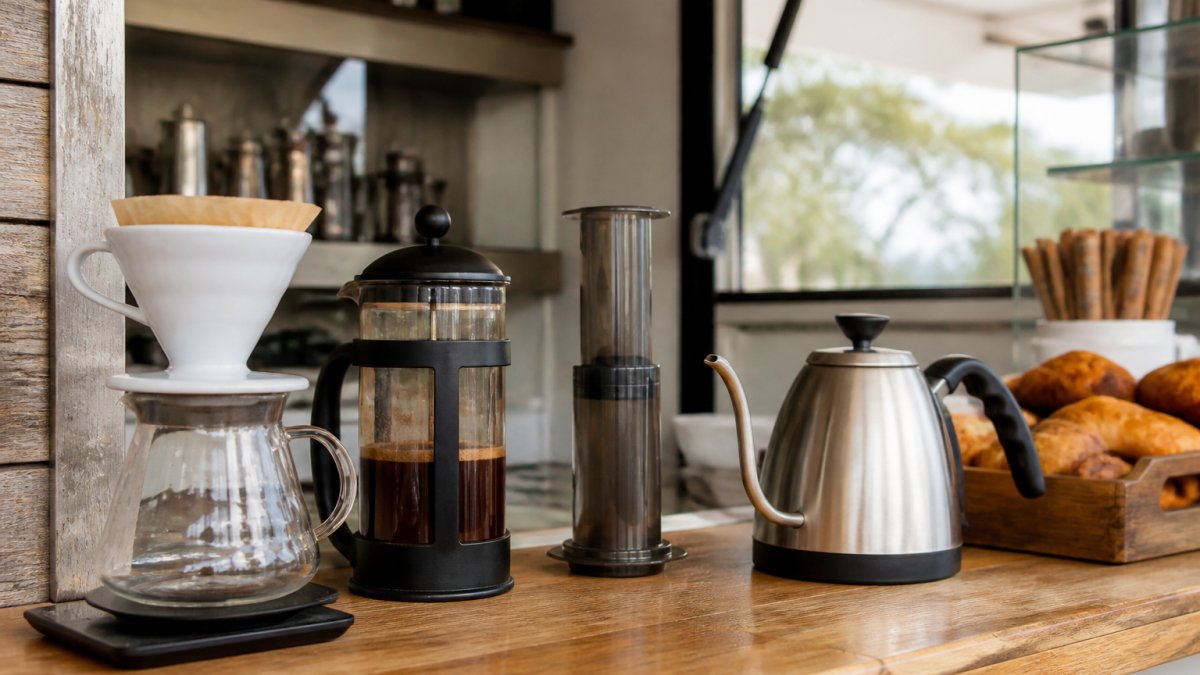
The real challenge isn't finding a good brewing method. It's finding one that fits your life.
At laffogatocoffee.com, we roast specialty beans for coffee enthusiasts who want premium flavor and are practical about space.
Different brewing approaches have vastly different footprints. A French press takes up minimal space and requires almost no electricity. Pour-over setups stack neatly in a cabinet.
The best brewing method for your small kitchen depends on three factors: how much counter real estate you can spare, how much cleanup you're willing to do, and whether you want to brew one cup or several at once. Pick the wrong method and you're stuck with equipment you can't use. Pick the right one and you'll actually brew coffee every day.
Best Small Coffee Makers That Fit Tight Spaces
When counter space is limited, your coffee maker becomes a permanent resident of your kitchen. It needs to earn its spot through compact design and reliable performance.
The most space-efficient coffee makers fall into two categories: single-serve brewers and collapsible manual methods. Single-serve machines like the OXO Brew 8-Cup Coffee Maker offer compact designs that don't sprawl across your counter. Manual methods like AeroPress or pour-over setups take up almost no room when not in use.
Electric drip makers work best if you have a dedicated corner. Look for models with a footprint under 12 inches wide.
Key features to prioritize:
- Footprint under 12 inches wide
- Integrated water reservoir or compact carafe
- Simple one-button operation (fewer moving parts = less to break)
- Dishwasher-safe components for quick cleanup
- Brewing capacity that matches your actual needs
If you brew for one person, a single-cup dripper beats any electric machine. If you brew for two or three people most mornings, a compact drip machine makes sense.
Pour-Over Coffee for Beginners: Minimal Equipment, Maximum Flavor
Pour-over brewing is the best coffee brewing method for small kitchens because it requires almost no equipment and produces exceptional flavor. You need three things: a dripper, a filter, and hot water. That's it.
What You'll Need
A basic pour-over setup costs under $15 and takes up less space than a coffee mug. Here's what to gather:
- Dripper: A ceramic, plastic, or metal cone that holds the grounds. Ceramic options like the Melitta or Chemex are beautiful and durable. Plastic drippers (often called "V60" or "Kalita Wave" style) are cheaper and nearly unbreakable.
- Filters: Paper or reusable metal filters. Paper filters produce cleaner cups. Metal filters let more oils through, creating fuller-bodied coffee. Paper filters cost pennies per use.
- Vessel: Any cup, mug, or carafe works. The dripper sits on top and drips directly into it.
- Kettle: Any kettle that heats water. A gooseneck kettle gives you better control, but a regular kettle works fine.
- Whole beans and grinder: Freshly ground coffee makes a measurable difference. A hand grinder works perfectly in small spaces.
Step-by-Step Brewing Process
Pour-over brewing takes 3-4 minutes from start to finish. Here's exactly how to do it:
Step 1: Grind your beans (1 minute) Grind medium-fine coffee. The texture should resemble sand, not powder. Use a ratio of 1 part coffee to 16 parts water. For a single cup (8 ounces), use 0.5 ounces of ground coffee.
Step 2: Place your filter and rinse (30 seconds) Put a paper or metal filter in your dripper.
Step 3: Add grounds and bloom (30 seconds) Pour your ground coffee into the filter. Pour just enough hot water to saturate the grounds. Let it sit for 30 seconds.
Step 4: Pour slowly and steadily (2-3 minutes) Pour water in slow circles over the grounds. Keep the water level consistent. Aim for a total brew time of 3-4 minutes. Too fast and your coffee tastes weak.
Step 5: Finish and enjoy Once water stops dripping, remove the dripper and drink. The entire process takes less time than waiting for an electric machine to finish.
French Press Coffee: Immersion Brewing Without Electricity
A French press brews coffee by steeping grounds directly in hot water. No filters, no electricity, no complicated steps. This method produces rich, full-bodied coffee that many enthusiasts prefer.
Setup and Cleanup Considerations
French press brewers are compact and durable. A standard 34-ounce model fits in a small cabinet and lasts for years.
The trade-off is cleanup. You're handling wet grounds directly. Some people love this tactile process. Others find it messy. The grounds go straight in the trash or compost.
French press strengths:
- Takes up minimal counter space
- No filters to buy (saves money long-term)
- Produces bold, flavorful coffee
- Durable glass or stainless steel construction
- Works with any heat source
French press weaknesses:
- Grounds settle at the bottom of your cup if you pour carelessly
- Cleanup requires rinsing wet grounds
- Glass breaks if you drop it (stainless steel models avoid this)
- Brew time is longer than pour-over (4-5 minutes)
A French press works best if you enjoy the ritual of manual brewing and don't mind a bit of sediment in your cup. If you want crystal-clear coffee, pour-over or AeroPress are better choices.
AeroPress Coffee Maker: Compact and Versatile
The AeroPress is a plastic cylinder that brews coffee using air pressure. It's the size of a water bottle, weighs almost nothing, and produces exceptional coffee. For small kitchens, it's nearly perfect.
Brewing Steps for Beginners
The AeroPress takes about 2 minutes to brew. Here's the standard method:
Step 1: Insert a filter Place a paper filter in the plastic cap. Rinse it with hot water.
Step 2: Add ground coffee Use a medium grind.
Step 3: Pour hot water Add 6 ounces of hot water (around 200°F). Stir for 10 seconds.
Step 4: Attach the cap Screw the cap with the filter onto the brewing chamber.
Step 5: Press down Place your cup on top and flip the whole thing upside down. Press down slowly over 20-30 seconds.
Step 6: Enjoy Remove the AeroPress and drink immediately. The entire process takes 2 minutes.
The AeroPress excels at single-cup brewing. It's durable, portable, and produces consistently excellent coffee. The only downside is brewing capacity, it makes one cup at a time. If you regularly brew for more than two people, a French press or small drip machine makes more sense.
Cold Brew and Single-Cup Methods for Minimal Footprint
Cold brew requires almost no equipment and produces smooth, low-acid coffee. You need a jar, coarse grounds, water, and time. That's genuinely all.
Cold Brew Storage and Space Efficiency
Cold brew brews overnight in your refrigerator. No counter space needed. In the morning, strain the grounds and you're done.
To make cold brew:
- Add 1 part coarse grounds to 4 parts water in a jar
- Stir well
- Cover and refrigerate for 12-24 hours
- Strain through a fine mesh or cheesecloth
- Dilute with water or milk when serving
Cold brew is ideal if you want to minimize daily effort. You brew once and forget about it. The downside is the long wait time.
Single-cup drippers like the Melitta or Kalita Wave are equally space-efficient. They cost under $10 and fold flat for storage. Use them when you want fresh coffee immediately without the wait.
Comparing Cleanup, Storage, and Equipment Count
Different brewing methods create different demands on your small kitchen. Here's how they compare:
| Method | Cleanup Time | Storage Space | Equipment Count | Best For |
|---|---|---|---|---|
| Pour-Over | 2 minutes | Minimal (stacks flat) | 3-4 items | Single cups, best flavor |
| French Press | 3-4 minutes | Small (one container) | 1 item | Bold coffee, batch brewing |
| AeroPress | 2-3 minutes | Minimal (fits in cabinet) | 2-3 items | Fast single cups, portability |
| Cold Brew | 1 minute (daily) | Small (one jar) | 1 item | Minimal daily effort |
| Electric Drip | 5 minutes | Medium (permanent fixture) | 1 item | Multiple cups, convenience |
Pour-over wins on space and cleanup. French press wins on simplicity and flavor. AeroPress wins on speed and portability. Cold brew wins on hands-off convenience. Electric drip wins if you brew multiple cups daily and don't mind a permanent counter fixture.
Choose based on your actual habits. If you make one cup every morning, pour-over or AeroPress. If you make three cups for your household, French press or small drip machine. If you forget to brew until you're already late, cold brew.
Common Mistakes to Avoid When Brewing in Small Spaces
Small kitchens force you to be intentional about every choice. Here are the mistakes that create real problems:
Mistake 1: Buying equipment you won't use A beautiful espresso machine looks inspiring. In a studio apartment, it becomes a dust-collecting sculpture. Buy only what you'll actually use daily. If you're not grinding beans and pulling shots every morning, skip the espresso machine.
Mistake 2: Choosing water temperature wrong Water that's too hot (over 210°F) over-extracts and tastes bitter.
Mistake 3: Using pre-ground coffee Pre-ground coffee loses flavor within days. Whole beans stay fresh for weeks.
Mistake 4: Ignoring the coffee-to-water ratio Most people use too little coffee.
Mistake 5: Storing beans in the wrong place Keep beans in an airtight container away from heat, light, and moisture.
Brewing excellent coffee in a small kitchen is entirely possible.
At laffogatocoffee.com, we roast specialty beans specifically for home brewers who care about quality.
Frequently Asked Questions
What is the best coffee brewing method for a small kitchen?
Pour-over and AeroPress methods rank highest for small kitchens because they require minimal counter space, few accessories, and easy cleanup. Both produce excellent coffee with just a dripper or device, hot water, and a kettle. Cold brew works well if you have refrigerator space but don't need counter room. The best choice depends on whether you prioritize speed, flavor, or storage convenience.
Which coffee brewing method takes up the least space?
Pour-over drippers and the AeroPress are the most compact brewing methods. A pour-over cone or flat-bottomed dripper measures just 3-4 inches wide and stores in a single cabinet shelf. The AeroPress is similarly small and stackable. Both require only a kettle and cup, making them ideal for kitchens where counter real estate is limited. Cold brew concentrate in a jar also minimizes footprint if you brew in advance.
Is a French press or pour-over better for a small kitchen?
Pour-over is generally better for small kitchens because the dripper stores easily and requires fewer pieces. French press takes up more counter space during brewing and needs a dedicated storage spot for the glass carafe. However, if you prefer immersion brewing and have refrigerator space for batch brewing, a French press still works, just plan for slightly larger footprint and longer cleanup time due to the glass vessel.
Can you make good coffee with a small coffee maker?
Yes. Small drip coffee makers, pour-over devices, and the AeroPress all produce high-quality coffee when you use fresh-roasted beans, proper water temperature (195-205°F), and correct grind size. The brewing method and water quality matter far more than equipment size. Many specialty coffee enthusiasts prefer manual brewing methods like pour-over specifically because they allow precise control over brew time and extraction, regardless of the maker's footprint.