 blog
How to Choose Between French Press and Pour Over Flavor
Quick Summary
The core french press vs pour over flavor difference comes down to filtration: a French press uses a metal mesh that lets oils and fine particles into the cup, giving a fuller, heavier body, while a pour-over uses a paper filter that traps them for a cleaner, brighter cup. Neither method is better overall, since each emphasizes different traits.
- A French press uses a metal mesh filter that lets oils and fine particles pass into the cup.
- A pour-over uses a paper filter that traps most oils and fines, producing a cleaner cup.
- French press steeps for several minutes; pour-over passes water through in a few minutes.
- French press tends to taste rich and heavy; pour-over tends to taste clearer and brighter.
- To compare fairly, brew the same beans both ways with the same water, dose and temperature.
Table of Contents
- French Press vs Pour Over Flavor: The Core Difference
- How Filtration Shapes Body, Clarity, and Sediment
- French Press vs Pour Over Taste: A Side-by-Side Tasting Method
- French Press vs Pour Over Grind Size and Why It Changes the Cup
- Best Coffee for French Press: Roasts and Origins That Shine
- Best Coffee for Pour Over: Matching Beans to a Clean, Bright Brew
- Choosing Your Next Brew and Ordering Beans Fresh from laffogatocoffee.com
- Frequently Asked Questions
French Press vs Pour Over Flavor: The Core Difference
Most coffee drinkers can tell a French press cup from a pour-over cup in one sip. The French press tends to feel rich and heavy on the tongue, while pour-over tastes cleaner and brighter. Knowing why those differences show up is the fastest way to pick the brew you'll actually enjoy. This guide breaks down what separates them.
The core difference comes down to filtration. A French press uses a metal mesh filter that lets oils and fine particles pass into the cup. A pour-over uses a paper filter that traps most of them. That single choice shapes almost everything you taste: body, clarity, and how much sediment settles at the bottom.
Flavor is also a matter of brewing time and contact. A French press steeps grounds in water for several minutes, so the coffee extracts gradually and holds onto its oils. A pour-over passes water through the bed in a few minutes, which tends to highlight acidity and fruit notes. Neither method is better across the board. They just emphasize different things.
How Filtration Shapes Body, Clarity, and Sediment
Filtration is where the two methods split most clearly. Paper filters are thin and dense, so they strip out most of the coffee oils and the finest grounds. The result is a lighter-bodied cup where individual flavor notes are easy to pick out.
Metal mesh filters let those oils and fine particles through. That creates the thick, velvety mouthfeel many people associate with a French press. It also leaves a layer of sediment at the bottom of the cup, which some drinkers love and others find gritty.
Watch out: if you pour the last bit of a French press into your mug, you will drink most of the sediment. Stop pouring when you reach the sediment layer, or let the grounds settle for a minute before serving.
French Press vs Pour Over Taste: A Side-by-Side Tasting Method
The easiest way to test the difference is to brew the same beans both ways on the same day, with the same water and the same dose. Most comparisons fail because the two cups differ in too many variables at once. A controlled tasting isolates the method so the flavor difference you taste is actually the method, not a different bean or a stale batch.
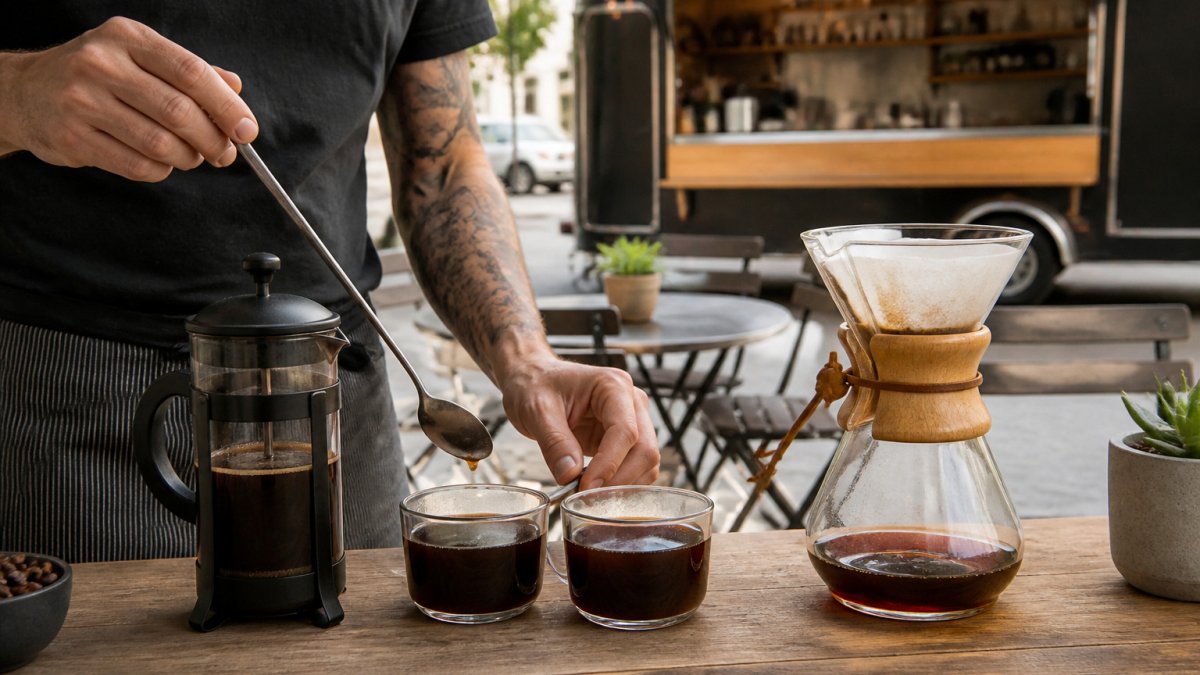
Set up the comparison this way:
- Same coffee, same roast date. Use one bag, weighed on the same scale, and note the roast date.
- Same water. Use the same water for both brews.
- Same dose and cup size. Weigh the dry coffee for each method and brew to the same finished volume so you are tasting strength differences from the method, not from a larger pour.
- Same temperature. Aim for water at the same temperature for both.
- Taste back to back, not hours apart. Brew the French press first, then the pour-over, and taste them within a few minutes of each other. Palate memory is short.
Before you sip, smell both cups. Aromatics often show the method difference before flavor does: the French press may smell rounder and sweeter, while the pour-over may smell sharper and more floral. Then take a small sip of each and score four traits on a simple one-to-five scale.
- Body: how heavy and coating the cup feels on your tongue. French press usually scores higher because oils and fine particles remain in the cup.
- Clarity: how easily you can separate one flavor note from another. Pour-over usually scores higher because the paper filter removes most oils and fines.
- Brightness: how sharp or lively the acidity seems. Pour-over tends to read brighter because the paper filter leaves a cleaner canvas for acidity.
- Finish: how long the taste lingers and whether it turns dry or sweet. French press often has a longer, heavier finish; pour-over often finishes shorter and cleaner.
Here is a simple comparison you can use as a starting expectation, not a rule:
| Trait | French Press | Pour Over |
|---|---|---|
| Body | Full, heavy, velvety | Light, clean |
| Clarity | Softer, more blended | Sharp, distinct notes |
| Sediment | Noticeable | Almost none |
| Acidity | Milder | Brighter |
| Finish | Longer, heavier | Shorter, cleaner |
| Best for | Chocolate and dark roast notes | Fruit and floral notes |
A common pattern is that the French press wins on comfort and the pour-over wins on detail. Neither result is universal. Try the same comparison with a light roast and a dark roast on separate days, and you will likely find that the gap between methods narrows with some beans and widens with others.
French Press vs Pour Over Grind Size and Why It Changes the Cup
Grind size changes the flavor as much as the brewing method does, and the two methods demand different targets because of how water meets coffee. In a French press, the grounds sit fully submerged for the entire steep, so the grind controls how much surface area is available over four to five minutes. In a pour-over, water passes through a relatively shallow bed in two to four minutes, so the grind controls both surface area and flow rate. That is why the same bag of beans can taste muddy in one method and thin in the other.
A French press generally calls for a coarse grind. For the pour-over side of the comparison, see how to make pour-over coffee step by step. Coarse particles expose less surface area per gram, which slows extraction during the long steep and keeps the metal mesh from passing too many fines into the cup. Grinding too fine lets too much material through the mesh, and the cup turns muddy, drying, and bitter at the edges. A useful test: after pressing, the slurry should settle into a distinct bed within about a minute. If the bed stays cloudy and suspended, the grind is likely too fine.
Pour-over calls for a medium grind, closer to table sand. Because the paper filter is fine, a finer grind still brews cleanly, and it gives you more control over extraction speed. If the grind is too coarse, water runs through too quickly, the bed drains before sugars and acids fully dissolve, and the cup tastes thin and sour. If it is too fine, the bed stalls, water pools on top, and the cup turns bitter and astringent. The drain-down time is your feedback loop: a pour-over that finishes far faster or slower than your usual recipe is telling you the grind moved.
Consistency matters as much as size. Uneven grounds extract at different rates, so fines over-extract while boulders under-extract, and you taste sour and bitter notes in the same cup. A burr grinder produces a narrower particle distribution than a blade grinder, and it is worth the investment if you brew both methods regularly. If you only own a blade grinder, pulse in short bursts and shake the grinder between pulses to reduce the dust and boulders.
Grind also interacts with dose and bed depth. A larger dose in a French press creates a deeper bed that traps heat and slows settling, so you may need to go slightly coarser. A larger pour-over dose deepens the bed and slows flow, so you may need to go slightly coarser there too. Change one variable at a time: adjust grind first, taste, then adjust ratio or time.
Best Coffee for French Press: Roasts and Origins That Shine
A French press can also make a lighter roast taste flat if the coffee is brewed too long.
Choose beans with rich, low-acid profiles for this method. Learn how roast level changes flavor before you pick a bag.
Best Coffee for Pour Over: Matching Beans to a Clean, Bright Brew
Because the method is so transparent, the bean's quality shows up quickly. Compare the main Italian and other brewing methods to see where pour-over fits. Freshness matters even more here. Coffee roasted within the last few weeks will taste clearer and more vibrant than older beans, and that difference is easy to notice in a clean cup.
Choosing Your Next Brew and Ordering Beans Fresh from laffogatocoffee.com
If you want a rich, full cup, a French press is the right tool. If you are still deciding, read a beginner-friendly comparison of specialty brewing methods before committing. If you prefer a bright, clear cup that shows off the bean, pour-over is the better match. Many people end up owning both, which is a reasonable choice given how differently they taste.
Whichever method you pick, freshness and roast choice will shape the result more than the gear. Fresh beans, a consistent grind, and a simple tasting routine will teach you more than any guide can.
Frequently Asked Questions
Which tastes stronger, French press or pour over?
French press usually tastes heavier and more intense because its metal mesh filter lets oils and fine particles through, which adds body and mouthfeel. Pour over, especially with a paper filter, removes most oils and fines, so the cup tends to read as lighter and cleaner. Strength also depends on your coffee-to-water ratio, so a stronger-tasting pour over is possible by brewing with more coffee. Try both methods with the same beans to see which profile you prefer.
Does pour-over coffee taste less bitter than French press?
Often it does, though the result depends on your technique. Paper filters trap some of the compounds and sediment that can contribute to a harsh or muddy bitterness, which is one reason pour over often tastes brighter. French press can taste bitter if the grind is too fine or the steep runs too long. Pour over can also turn bitter if you over-extract by pouring too slowly or using water that is too hot.
What coffee roast works best for French press and pour over?
For French press, a medium to medium-dark roast gives chocolatey, full-bodied results that suit the method's heavier texture. For pour over, a light to medium roast with clear acidity highlights the distinct flavor notes of a single origin.
Is French press or pour over healthier?
Paper-filtered pour over removes most of the cafestol and kahweol oils that can raise cholesterol levels, while French press leaves them in the cup. Both methods are generally considered acceptable for most adults in moderate amounts. If you have concerns about cholesterol, a paper-filter method is the more cautious choice.