 listicle
5 Best Manual Coffee Grinders for Beginners
Table of Contents
- Manual Coffee Grinders for Beginners: Quick Comparison
- How to Choose a Manual Coffee Grinder: A Buying Guide
- 1Zpresso J: Overall Best Manual Coffee Grinder for Beginners
- Timemore Chestnut C2: Best Budget Manual Coffee Grinder
- Manual Coffee Grinder for Pour Over: Comandante C40
- How to Use a Manual Coffee Grinder: Step-by-Step
- More Top Picks: 1Zpresso J Ultra and ZP6 Special
- Common Mistakes Beginners Make With Manual Grinders
- Frequently Asked Questions
Last Updated: October 15, 2026
Manual Coffee Grinders for Beginners: Quick Comparison
Choosing your first manual coffee grinder doesn't have to be overwhelming, and we've identified the 5 best manual coffee grinders for beginners to help you start. A quality hand grinder is one of the best investments you can make if you're serious about brewing better coffee at home.
The 5 best manual coffee grinders for beginners balance ease of use, grind consistency, and value. Whether you're brewing pour-over, French press, or espresso, the right grinder makes a measurable difference in cup quality. Below, we'll walk you through how to choose, then show you our top picks with honest pros and cons for each.
Quick Picks:
- Best Overall: 1Zpresso J, ideal balance of grind range and ease of use for most brewing methods
- Best Budget Option: Timemore Chestnut C2, entry-level price with reliable performance
- Best for Pour-Over: Comandante C40, precision grind adjustment for filter coffee clarity
How to Choose a Manual Coffee Grinder: A Buying Guide
Picking the right manual coffee grinder comes down to three core factors: burr type, adjustment range, and grinding effort. Each one affects how your coffee tastes and how much work you'll put in every morning.
Burr Type and Grind Consistency
The burr type determines grind consistency and particle uniformity more than any other factor. Manual coffee grinders use one of two designs: conical burrs or flat burrs.
Conical burrs work by crushing beans between a rotating cone and a stationary ring. They're forgiving for beginners because they produce fairly uniform particle size even if your grinding speed varies.
Flat burrs use two parallel grinding surfaces. They produce slightly more uniform particles, but they're more sensitive to grinding speed and technique. If you grind too fast, you'll get more fines (powder). Too slow, and you'll have larger chunks.
Adjustment Range and Settings
The adjustment range tells you how fine or coarse you can grind. Most manual grinders for beginners offer between 15 and 40 different grind settings, measured in microns or clicks.
For espresso, you need very fine settings (under 200 microns). For French press, you want coarse settings (400+ microns). Pour-over sits in the middle, typically around 200-300 microns.
Click adjustment (where each turn clicks into a defined position) is easier for beginners than infinitely adjustable grinders. You can dial in a setting and return to it consistently without guessing.
Grinding Effort and Ergonomic Design
Manual grinding requires physical effort. The amount varies wildly between grinders. A poorly designed grinder with a short handle and stiff burrs can turn your morning into a workout. A well-designed one should take 60-90 seconds to grind enough beans for one cup.
Handle length, grip comfort, and the weight of the grinder matter here. Longer handles give you better use. Rubberized grips reduce hand fatigue. A grinder that sits stable on your counter (instead of spinning away) saves frustration.
1Zpresso J: Overall Best Manual Coffee Grinder for Beginners
The 1Zpresso J is the most balanced manual coffee grinder for beginners. It handles multiple brew methods without compromise, grinds smoothly, and won't exhaust you every morning.
What makes it stand out: the grind range spans from fine espresso settings to coarse French press, so you're not locked into one brewing style. The conical burrs produce consistent particle uniformity across the range.
The adjustment mechanism uses micron-based settings, which means you get precise, repeatable results. Set it to a number, grind, taste, and adjust by a few microns if needed. This precision matters when you're dialing in a new coffee.
Pros:
- Broad grind range covers all major brew methods
- Smooth grinding action with minimal effort
- Repeatable micron adjustments
- Durable all-metal construction
Cons:
- Slightly heavier than some competitors
- Takes time to dial in if you switch brew methods frequently
Timemore Chestnut C2: Best Budget Manual Coffee Grinder
If you're testing whether manual grinding fits your routine, the Timemore Chestnut C2 proves you don't need to spend heavily. It's the most affordable option here without sacrificing core performance.
The C2 uses conical burrs and offers enough adjustment range for filter coffee and French press. It won't handle fine espresso settings, but if you're brewing pour-over or immersion methods, it delivers consistent results.
The real win with the C2 is value. You get a functional, reliable grinder at a fraction of premium prices. It's ideal for beginners who want to confirm they'll actually use manual grinding before investing more.
Pros:
- Entry-level price point
- Compact and portable
- Smooth conical burrs
- Good for filter coffee and French press
Cons:
- Limited fine adjustment for espresso
- Smaller capacity than premium models
- Not ideal if you want maximum grind range
Manual Coffee Grinder for Pour Over: Comandante C40
For pour-over brewers specifically, the Comandante C40 is the precision choice. It's engineered for the grind consistency that filter coffee demands.
The C40 uses flat burrs with a narrow adjustment range optimized for filter coffee. This isn't a limitation, it's intentional design. Pour-over brewing benefits from precise, uniform grind size. The C40 delivers that.
The grinding action is smooth, though it requires slightly more effort than conical-burr grinders. The handle design provides good use, so effort isn't excessive. If you're brewing pour-over daily and want the best possible clarity and taste profile, this grinder pays for itself in cup quality.
Pros:
- Flat burrs produce exceptional clarity for filter coffee
- Precise adjustment for dialing in
- Lightweight and portable
- Excellent build quality
Cons:
- Limited grind range outside filter coffee
- Requires slightly more grinding effort
- Higher price point than budget options
How to Use a Manual Coffee Grinder: Step-by-Step
Learning to use a manual coffee grinder correctly takes about three brewing sessions. After that, it becomes routine. Here's exactly how to do it.
Setting Your Grind Size
Start by determining what grind size your brew method needs. Pour-over typically uses a medium-fine grind. French press uses coarse. Espresso uses very fine.
Turn the adjustment mechanism slowly while watching how the burrs move inside (most grinders have a viewing window). You're looking for the setting that matches your brew method.
Grind a small test batch, about half what you need for one cup. Check the consistency. Particles should look uniform, not a mix of powder and chunks. If you see lots of fines (powder), go one or two settings coarser.
Grinding and Dialing In
Fill the hopper with whole beans. Don't overstuff it; a typical hopper holds 20-30 grams. Place your cup or a small container under the grinder spout.
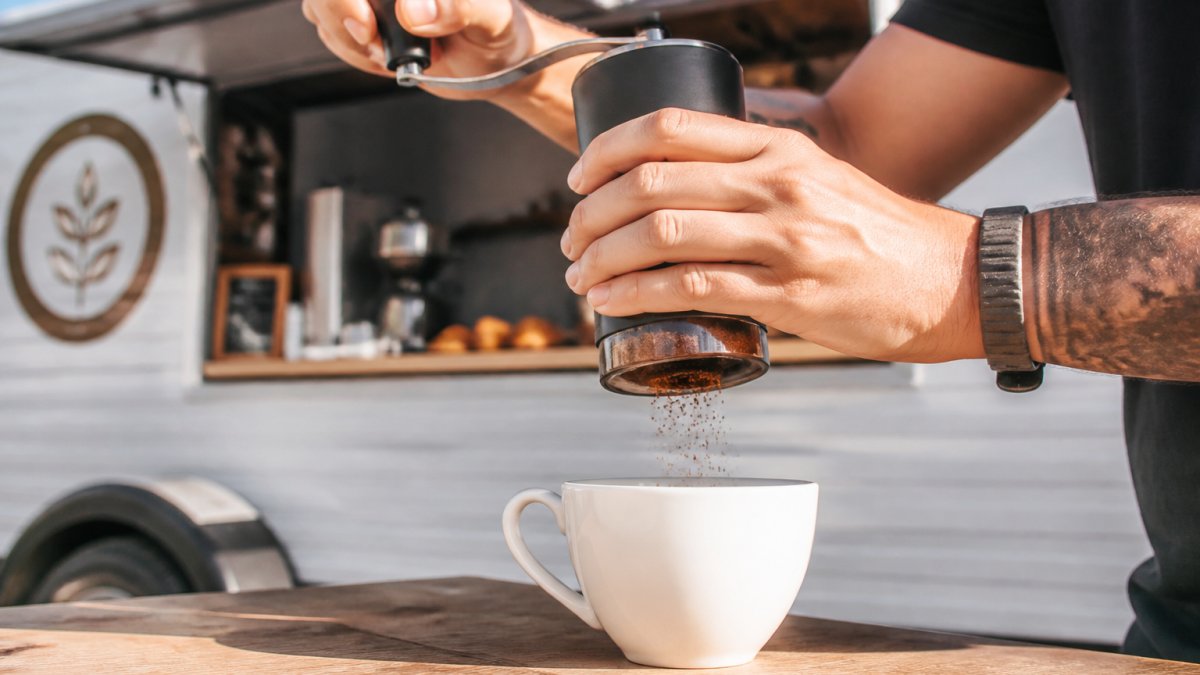
Hold the grinder steady on your counter or between your knees. Grip the handle firmly and turn it in smooth, even strokes. Don't rush. Rushing creates uneven pressure and inconsistent grind size. Aim for 60-90 seconds of grinding for a single-cup dose.
After grinding, inspect the result. If particles look uniform and you see minimal dust, your technique is solid. If the grind looks inconsistent, adjust your speed or the grind setting and try again.
Cleaning and Maintenance
Manual grinder maintenance is straightforward. After each use, remove any remaining grounds from the hopper and burr chamber. A small brush works well. Don't use water inside the grinder unless the manufacturer explicitly approves it.
Every month or two, depending on use, run a small amount of rice through the grinder to clean the burrs. The rice absorbs oils and residue. Grind it completely, then discard.
Check the adjustment mechanism occasionally to ensure it moves freely. If it feels stiff, a tiny amount of food-grade oil on the threads helps. Use sparingly, you don't want oil near the burrs themselves.
More Top Picks: 1Zpresso J Ultra and ZP6 Special
Beyond the main three, two other manual grinders deserve mention for specific use cases.
1Zpresso J Ultra offers an even broader grind range than the standard J. It handles espresso through French press with 8-micron adjustment increments. If you brew multiple methods and want maximum flexibility, the J Ultra is worth the extra investment.
ZP6 Special excels with light-roast coffee and high brew ratios. It produces a clear, clean-tasting cup when you're using fruity, single-origin beans. The grind consistency emphasizes clarity over body, which suits filter coffee enthusiasts who prioritize taste profile over everything else.
Common Mistakes Beginners Make With Manual Grinders
Most beginners struggle with three things. Knowing what they are saves months of frustration.
Grinding too fast. Speed creates uneven pressure on the beans. This produces inconsistent particle size, some fines, some chunks. Slow down.
Not dialing in before brewing. Many beginners grind at a random setting, brew, and wonder why the coffee tastes off. Take 10 minutes to dial in.
Ignoring the adjustment range. The adjustment range on your grinder exists for a reason. If you're only using the middle 5 settings, you're missing options.
| Grinder | Best For | Key Feature | Adjustment Type |
|---|---|---|---|
| 1Zpresso J | All-around brewing | Broad grind range | Micron-based |
| Timemore Chestnut C2 | Budget-conscious beginners | Affordable entry point | Click-based |
| Comandante C40 | Pour-over enthusiasts | Flat burrs for clarity | Precise adjustment |
| 1Zpresso J Ultra | Maximum flexibility | Extended grind range | 8-micron increments |
| ZP6 Special | Light-roast specialists | Clean cup profile | Optimized for clarity |
At laffogatocoffee.com, we believe the grinder you choose shapes every cup you brew.
The best manual coffee grinder for beginners is the one you'll actually use every day. If you're sourcing fresh-roasted beans to go with your new grinder, laffogatocoffee.com specializes in Italian-roasted specialty coffee that rewards the care you put into grinding and brewing.
Frequently Asked Questions
What should beginners look for in a manual coffee grinder?
Beginners should prioritize grind consistency, adjustment range, and ease of use. Look for burr grinders with micron-level adjustment so you can dial in your grind for different brew methods. Consider the grinding effort required, lighter resistance means less fatigue during daily grinding. A capacity of 30-50 grams works well for most home brewers. Start with a grinder that handles filter coffee and pour-over well before moving to espresso-specific models.
Are manual coffee grinders good for beginners?
Yes, manual coffee grinders are ideal for beginners. They're affordable, require no electricity, and force you to understand the relationship between grind size and brew method. Hand grinders teach you to feel the grinding resistance and develop consistency. They're portable, durable, and produce particle uniformity comparable to electric models at a fraction of the cost. The main trade-off is grinding speed, but this slowness actually helps beginners learn control.
Can a manual coffee grinder grind beans for espresso?
Most manual coffee grinders can produce espresso-fine grinds, but not all are ideal for it. Espresso requires very fine, uniform particles and consistent dosing. Grinders with larger burrs and finer adjustment ranges (8-micron or smaller) work best for espresso. However, beginners often find espresso challenging with manual grinders because you need precise technique and significant grinding effort. Start with filter coffee or pour-over to build skills, then upgrade to an espresso-capable model if needed.
How much should a beginner spend on a manual coffee grinder?
Budget manual grinders can be a good starting point for beginners learning the basics. Mid-range models often provide enhanced burr quality, finer adjustment, and more comfortable handles. Premium options typically offer precision and durability for long-term daily use. For beginners, a grinder that balances affordability with enough features to explore different brew methods is often recommended. It's generally advisable to avoid the cheapest options, as they may produce inconsistent grinds that make dialing in difficult.
What's the difference between manual coffee grinder for pour over versus espresso?
Pour-over grinders need a medium-coarse grind with good particle uniformity but less extreme fineness. They require moderate adjustment range and grinding effort. Espresso grinders must produce very fine, consistent particles and need finer adjustment increments (micron-level) and stronger burrs to handle the density. Pour-over grinders are lighter, faster to use, and beginner-friendly. Espresso grinders are heavier, require more grinding effort, and demand precise technique. Start with a pour-over-capable grinder as a beginner.