 blog
blog
7 Best Specialty Coffee Brewing Methods for Beginners
Table of Contents
- Why Specialty Coffee Brewing Methods Matter for Beginners
- Coffee Brewing Methods for Beginners: A Practical Selection Guide
- Pour-Over Coffee for Beginners: Step-by-Step Recipe
- French Press Coffee Ratio and Technique
- AeroPress Brewing: Versatile and Forgiving
- Cold Brew, Moka Pot, and Siphon Methods
- Understanding Coffee-to-Water Ratio for Consistent Results
- Common Brewing Problems and How to Fix Them
- Frequently Asked Questions
Last Updated: October 11, 2026
Why Specialty Coffee Brewing Methods Matter for Beginners
Getting into specialty coffee doesn't require years of training or expensive equipment. Switching to specialty coffee brewing methods opens up flavors most people never knew existed, fresh-roasted beans, proper water temperature, and the right technique create a cup completely different from instant or drip-only coffee. You control every variable: grind size, water temperature, brew time, and coffee-to-water ratio. Some methods are forgiving for beginners; others reward precision. All produce better-tasting coffee than convenience-first approaches.
Coffee Brewing Methods for Beginners: A Practical Selection Guide
The best brewing method depends on five practical factors: available time, cleanup tolerance, equipment budget, grinder access, and desired flavor profile.
Decision Framework: Match Your Lifestyle
Time commitment: Under 3 minutes (AeroPress, drip), 3-4 minutes (pour-over), 4 minutes (French press, Moka pot), 12-24 hours passive (cold brew), 5-10 minutes (siphon).
Equipment cost: French press ($15-$30) or AeroPress ($30-$40) for budget entry; pour-over dripper ($10-$50) + gooseneck kettle ($25-$60) for mid-range; siphon ($40-$100+) for higher investment. Most methods require a burr grinder.
Learning curve: AeroPress and cold brew are most forgiving. French press and drip are moderate. Pour-over, Moka pot, and siphon require precision.
Cleanup: Drip and cold brew are easiest. AeroPress and pour-over are quick. French press, Moka pot, and siphon require more attention.
Flavor profile: Pour-over produces bright, clean flavors; French press creates full-bodied richness; AeroPress offers balanced clarity; cold brew delivers smooth sweetness; Moka pot produces bold concentration; siphon creates complex delicacy.
Recommended Starting Points by Beginner Profile
"I want the easiest entry point": Start with AeroPress or cold brew, both are nearly impossible to ruin and produce excellent cups.
"I enjoy ritual and have 10 minutes": Start with pour-over. Invest in a gooseneck kettle and a simple scale for consistency.
"I want bold, full-bodied coffee": Start with French press. You'll need a burr grinder and a kettle.
"I have limited space or travel frequently": Start with AeroPress. It's the most portable method and requires minimal cleanup.
"I want to explore specialty coffee deeply": Start with pour-over, then add AeroPress after mastering it. These two methods teach how technique shapes flavor.
The One Rule: Master One Method First
Pick one method and brew with it at least 10 times using the same beans, ratio, and technique before adding a second method. This builds real coffee knowledge instead of surface familiarity with many methods.
Pour-Over Coffee for Beginners: Step-by-Step Recipe
What You'll Need:
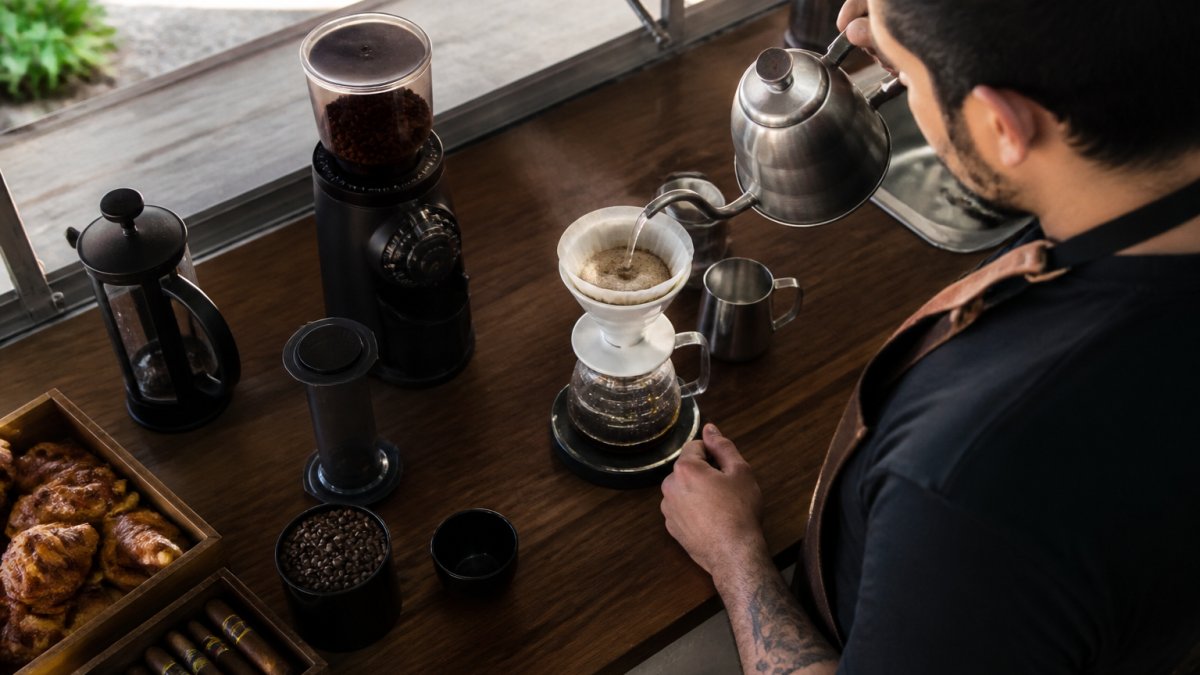
- Pour-over dripper (Hario V60, Melitta, or Chemex)
- Paper or metal filter
- Whole coffee beans
- Burr grinder
- Gooseneck kettle (optional but helpful)
- Scale (optional but recommended)
- Hot water (195-205°F)
Step-by-step pour-over brewing:
- Grind medium-fine (like table salt) right before brewing.
- Heat water to 195-205°F.
- Rinse the filter with hot water.
- Add grounds using a 1:16 coffee-to-water ratio.
- Bloom with just enough water for 30-45 seconds to release CO2.
- Pour slowly in circular motions over 2-3 minutes.
- Finish at 3-4 minutes total brew time for a clean, balanced cup.
Most beginners pour too fast or use water that's too hot. The coffee-to-water ratio matters more than exact timing.
French Press Coffee Ratio and Technique
French press coffee-to-water ratio:
Use a 1:15 ratio (1 gram coffee to 15 grams water). For a standard 34-ounce French press, that's about 0.9 ounces (25 grams) of coffee to 13.5 ounces (400 milliliters) of water.
Step-by-step French press brewing:
- Grind coarse (like breadcrumbs).
- Heat water to 195-205°F.
- Add grounds and water, stir gently.
- Steep for 4 minutes.
- Press slowly over 20-30 seconds.
- Pour immediately to avoid over-extraction.
AeroPress Brewing: Versatile and Forgiving
AeroPress coffee-to-water ratio:
Use a 1:17 ratio (1 gram coffee to 17 grams water). For a standard AeroPress, that's about 0.35 ounces (10 grams) of coffee to 6 ounces (175 milliliters) of water.
Step-by-step AeroPress brewing:
- Grind medium (like fine sand).
- Heat water to 195-205°F.
- Assemble and create a seal.
- Add grounds and water, stir for 10 seconds.
- Steep for 1 minute.
- Press slowly over 20-30 seconds until you hear a hiss.
Cold Brew, Moka Pot, and Siphon Methods
Cold Brew: The Hands-Off Specialty Method
Cold brew coffee-to-water ratio:
Use a 1:4 ratio (1 part coffee to 4 parts water by weight). For a standard 32-ounce jar, that's about 0.5 ounces (14 grams) of coarse ground coffee to 7 ounces (200 milliliters) of water. This produces a concentrate; dilute with water or milk to taste.
Step-by-step cold brew brewing:
- Grind coarse and add to a jar with cold filtered water.
- Steep 12-24 hours at room temperature or refrigerated.
- Strain through fine-mesh strainer or cheesecloth.
- Dilute 1 part concentrate with 1-2 parts water or milk. Keeps 2 weeks refrigerated.
Moka Pot: Stovetop Espresso-Style Brewing
Moka pot coffee-to-water ratio:
Use a 1:2 ratio (1 part coffee to 2 parts water by weight). For a standard 3-cup Moka pot (holds about 3 ounces or 90 milliliters of brewed coffee), use about 0.5 ounces (14 grams) of finely ground coffee to 1 ounce (30 milliliters) of water in the bottom chamber.
Step-by-step Moka pot brewing:
- Fill bottom chamber to the safety valve with cold filtered water.
- Grind medium-fine and add to the basket without tamping.
- Assemble chambers tightly.
- Heat on medium for 5-8 minutes until you hear a gurgle.
- Remove from heat immediately and pour into your cup.
Common issues: Bitter coffee = heat too high; weak coffee = grind too coarse; sputtering = basket clogged; leaking = chambers not tight enough.
Siphon Brewing: Advanced but Rewarding
Siphon brewing uses vapor pressure and gravity to create an exceptionally clean cup. A siphon has two chambers: as water heats, vapor pressure pushes it into the upper chamber where it mixes with grounds. When you remove heat, the brewed coffee is pulled back down through a filter into the lower bowl.
Siphon coffee-to-water ratio:
Use a 1:16 ratio (1 gram coffee to 16 grams water). For a standard 3-cup siphon (holds about 10 ounces or 300 milliliters), use about 0.6 ounces (18 grams) of coffee to 10 ounces (300 milliliters) of water.
Step-by-step siphon brewing:
- Prepare filter (cloth or metal) with hot water.
- Fill lower bowl to marked line with 195-205°F water.
- Assemble chambers with tube submerged.
- Heat until water rises to upper chamber (about 1 minute).
- Add medium-fine grounds, stir for 10 seconds.
- Brew for 1-1.5 minutes with gentle heat.
- Remove heat and let coffee drain back to lower bowl (20-30 seconds).
- Remove upper chamber carefully and pour immediately.
Why siphon brewing is worth learning:
Siphon brewing produces a cup with exceptional clarity and complexity because the paper or cloth filter removes all oils and sediment, similar to pour-over. However, the precise temperature control and the unique extraction method highlight subtle flavors that other brewing methods can miss. Siphons are also beautiful to watch, making the brewing process feel like a ritual.
Siphon brewing challenges: Siphons are expensive ($40-$100+) and require a heat source. Temperature, heat level, and timing all matter and take practice to dial in. Multiple parts require careful cleaning. Glass chambers can break if handled roughly.
Common siphon issues: Weak or sour coffee means brew time is too short, extend to 1.5 minutes. Bitter coffee means brew time is too long, reduce to 1 minute. Water won't rise means heat is too low, increase slightly. Coffee drains too quickly means heat is too low, maintain steady heat.
Understanding Coffee-to-Water Ratio for Consistent Results
The coffee-to-water ratio is the single most important variable for consistency. A ratio of 1:15 to 1:17 is standard for most brewing methods. Use 1:14-1:15 for stronger cups, 1:16-1:17 for standard, and 1:18+ for weaker cups. Stick with one ratio for at least five brews, changing only one variable at a time.
A simple kitchen scale costs under $20 and removes all guesswork. Consistency builds flavor knowledge faster than anything else.
Common Brewing Problems and How to Fix Them
Bitter, over-extracted taste:
- Your brew time is too long or your water is too hot
- Grind coarser or reduce brew time by 30 seconds
- Let hot water cool to 195-205°F before brewing
Sour, under-extracted taste:
- Your brew time is too short or your water is too cool
- Grind finer or extend brew time by 30 seconds
- Use hotter water (closer to 205°F)
Weak, watery cup:
- Your coffee-to-water ratio is off
- Use more coffee or less water
- Check that you're using whole beans, not pre-ground coffee that's been sitting for weeks
Muddy or gritty texture:
- Your grind is too fine for your brewing method
- You're using a metal filter when you should use paper
- You pressed too fast (French press) or didn't rinse your filter (pour-over)
Flat, one-dimensional flavor:
- Your beans aren't fresh or aren't specialty coffee
- Fresh-roasted specialty beans make a dramatic difference
- Check the roast date on the bag and use beans within 2-4 weeks of roasting
The most common mistake is blaming the beans when the real problem is technique. Fresh specialty coffee beans can only perform well if you dial in your brewing method.
Getting into specialty coffee brewing methods doesn't require expensive equipment or years of practice. Pick one method, master the coffee-to-water ratio and water temperature, and practice consistency. Fresh-roasted specialty beans deserve proper brewing technique. At laffogatocoffee.com, we roast beans specifically for home brewing. Explore our specialty coffee selection to find beans that match your brewing style.
Frequently Asked Questions
What is the best coffee-to-water ratio for beginners?
A good starting point is a 1:16 ratio, one part coffee to 16 parts water by weight. For example, 25 grams of ground coffee with 400 milliliters of water. This produces a balanced cup for most brewing methods. If your coffee tastes weak, decrease the ratio to 1:15; if it's too strong, increase to 1:17. Specialty coffee brewing methods often benefit from this precise approach, and a simple kitchen scale removes guesswork.
Is pour-over or French press easier for beginners?
French press is generally easier because it requires less technique, you add grounds, pour hot water, wait, and plunge. Pour-over demands more precision with pouring technique and water temperature control. However, pour-over coffee for beginners often produces clearer, brighter flavors because paper filters trap oils. Choose French press if you prioritize simplicity; choose pour-over if you want to learn proper brewing fundamentals from the start.
What grind size should I use for different coffee brewing methods?
Coarse grind works for French press and cold brew (steep methods where grounds sit in water longer). Medium grind suits pour-over and AeroPress. Fine grind is for espresso and Moka pot. Siphon brewers typically use medium-fine grind. Using the wrong grind size is a common mistake, too fine causes over-extraction and bitterness; too coarse produces weak, under-extracted coffee. A burr grinder lets you adjust grind size precisely.
How long does it take to brew specialty coffee at home?
Brew times vary by method. Pour-over takes 2.5-4 minutes. French press requires 4 minutes of steeping. AeroPress brews in 1-2 minutes. Cold brew needs 12-24 hours. Moka pot takes 5-10 minutes on the stovetop. Siphon brewing takes 5-10 minutes. Beginners often start with methods under 5 minutes, like pour-over or AeroPress, to practice technique without long waits between attempts.