 how-to
Is Making Authentic Biscotti Really Hard for Beginners
Last Updated: November 7, 2026
Quick Summary
Making authentic biscotti is not hard for beginners, rating about a three out of ten for most home bakers. The dough comes together in one bowl with no yeast or proofing, and a first batch takes roughly 90 minutes. The real challenge is the second bake and slicing the logs at the right moment.
- Let logs cool 15 to 20 minutes before slicing, or they tear and crumble.
- Mix just until no traces of flour remain to avoid tough, chewy biscotti.
- Slice about 1/2 inch thick with a serrated knife in a gentle sawing motion.
- Second bake 15 to 20 minutes, flipping once, until slices look dry and pale gold.
- Toast almonds at 350°F for 8 to 10 minutes for deeper flavor, adding 15 minutes.
Table of Contents
- The Honest Difficulty Rating for Authentic Biscotti
- Why Are Biscotti So Hard for Some Bakers
- A Realistic Time Breakdown for Your First Batch
- Building the Authentic Italian Biscotti Recipe
- How to Slice Biscotti Without Crumbling
- Visual Doneness Cues for Both Bakes
- What Makes the Best Italian Biscotti Recipe Work
- Troubleshooting Texture and Controlling Final Hardness
- Frequently Asked Questions
The Honest Difficulty Rating for Authentic Biscotti
Is it hard to make authentic biscotti? No. On a scale of one to ten, biscotti land at about a three for most home bakers. The dough comes together in one bowl, there is no yeast and no proofing, and the whole process takes roughly 90 minutes from mixing bowl to cooling rack.
What trips people up is not the mixing. It is the second bake and the slicing in between. Get those two steps right and you have crisp, nutty cookies that hold up to coffee. Get them wrong and you get either a crumbly mess or a batch of almond rocks.
Many beginners find the same steps tricky, so the timing and visual cues below focus on exactly where people tend to lose their footing. Below, we break down the real difficulty, the timing, and the exact cues that tell you when each bake is done.
Why Are Biscotti So Hard for Some Bakers
Biscotti are hard for some bakers because the recipe punishes two common habits: overworking the dough and rushing the second bake. Both problems show up late, when the cookies are already shaped and baked.
The dough itself is forgiving. Flour, sugar, eggs, butter or oil, baking powder, and almonds come together fast. A common mistake is mixing until smooth like cookie dough. Biscotti dough should look shaggy and slightly tacky, then come together with a few gentle kneads on the counter.
The Two-Bake Trap and Overmixing
The two-bake method is what makes biscotti, biscotti. The first bake sets the log. The second bake dries the slices into that signature crunch.
Watch out: skipping or shortening the second bake leaves you with soft, cakey cookies that go stale in a day. Overmixing, meanwhile, develops gluten and gives you tough, chewy biscotti instead of crisp ones. Mix just until no traces of flour remain, then stop.
A Realistic Time Breakdown for Your First Batch
Your first batch takes about 90 minutes of active and passive time combined, and most of that is waiting rather than working. Here is where the minutes go, what you do, and what the dough or cookie should look and feel like before you move to the next stage:
| Stage | Time | What You Do | What It Should Look and Feel Like |
|---|---|---|---|
| Mixing the dough | 10 minutes | Combine wet and dry, fold in almonds | Shaggy and slightly tacky, no dry flour streaks, almonds evenly distributed |
| Shaping logs | 5 minutes | Form two flat logs on a lined sheet | Logs about 3 inches wide and 3/4 inch tall, edges smoothed, dough holds its shape |
| First bake | 25-30 minutes | Bake until lightly golden and set | Edges light brown, top firm with a slight spring when pressed, toothpick in the center comes out clean |
| Cooling before slicing | 15-20 minutes | Let logs rest until warm, not hot | Log feels warm but not hot to the touch, firm enough to hold its shape under light pressure |
| Slicing | 5 minutes | Cut on a slight diagonal | Slices about 1/2 inch thick, clean faces, minimal crumbling |
| Second bake | 15-20 minutes | Dry the slices, flipping once | Slices look dry and pale gold on both sides, no glossy or soft spots in the center, cookie feels light for its size |
| Full cooling | 20 minutes | Cool completely for maximum crunch | Cookie is crisp through, snaps cleanly, and no longer feels warm in the center |
Time
Add 15 minutes if you toast the almonds first. That step is optional but worth it for deeper flavor. Toast them at 350°F for 8 to 10 minutes, until fragrant and lightly browned, then cool before folding into the dough.
Watch out: the cooling window between bakes is the step beginners rush most. A log sliced while still hot will tear and crumble, and those broken slices never recover their shape in the second bake. Set a timer for 15 minutes and test the log with light pressure before you pick up the knife.
If you want the right coffee brewing method to serve alongside your finished batch, our guide to Italian coffee brewing methods covers the options.
Building the Authentic Italian Biscotti Recipe
An authentic Italian biscotti recipe starts with the classic formula: flour, sugar, eggs, a little fat, baking powder, salt, and whole almonds. Traditional Tuscan cantucci keep it simple. No chocolate chips, no glaze, just almonds and a clean, crunchy texture.
The dough should feel firm enough to shape and just slightly sticky. If it clings to your hands, dust with a spoonful of flour. If it crumbles, add a teaspoon of water.
Ingredients and Traditional Add-Ins
Here is what belongs in a traditional batch:
- All-purpose flour as the base
- Granulated sugar, not brown
- Eggs for structure and richness
- Butter or olive oil for tenderness
- Baking powder for a modest lift
- Whole or sliced almonds, the classic choice
- A pinch of salt to balance the sweetness
- Vanilla or almond extract for aroma
Traditional add-ins beyond almonds include pistachios, dried cranberries, and orange zest. Chocolate chips push the recipe toward American biscotti, which is fine, just not traditional.
Once your biscotti are baked, they pair beautifully with Italian pastries and coffee. Our guide to Italian pastry and coffee pairings shows what to serve next to them.
How to Slice Biscotti Without Crumbling
Slice biscotti without crumbling by letting the logs cool for 15 to 20 minutes first, then cutting with a serrated knife in a gentle sawing motion. Warm logs slice cleanly. Hot logs fall apart.
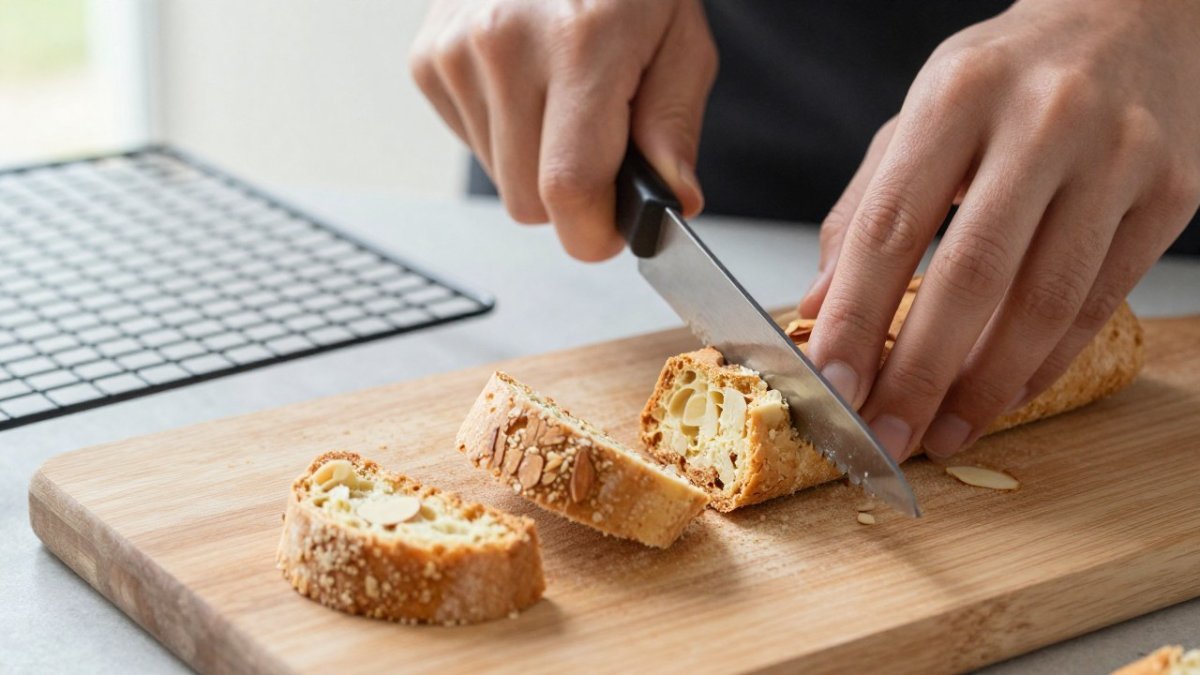
A few habits protect the slice:
- Use a serrated knife, never a straight chef's knife
- Cut on a slight diagonal for longer cookies
- Use light pressure and let the blade do the work
- Cut slices about 1/2 inch thick
- Support the log with your free hand as you go
If a slice breaks, don't toss it. Broken pieces still crisp up in the second bake and taste just as good.
Visual Doneness Cues for Both Bakes
Visual cues tell you more than the timer. For the first bake, look for a log that is set and lightly golden at the edges, with a slight spring when pressed. For the second bake, look for slices that are dry and pale gold on both sides, with no soft spots in the center.
Here is what to watch for at each stage:
- First bake: edges turn light brown, top feels firm
- First bake: a toothpick in the center comes out clean
- Second bake: slices look dry, not glossy
- Second bake: edges darken slightly after flipping
- Second bake: the cookie feels light for its size
If the slices still feel soft after 15 minutes, give them 5 more. The oven does the rest.
What Makes the Best Italian Biscotti Recipe Work
The best Italian biscotti recipe works because of restraint. Few ingredients, gentle mixing, and a patient second bake produce a cookie that is crisp and substantial without being unpleasantly hard.
Biscotti should feel crisp and substantial, but not so hard that they are unpleasant to eat. That balance is the whole game.
Flavor comes from good almonds and a little extract, not from a long ingredient list. Toast the nuts first to bring out their oils. Use fresh eggs and real butter or good olive oil.
If you want a classic Italian coffee dessert to serve with your biscotti, our guide to making authentic affogato walks through it step by step.
Troubleshooting Texture and Controlling Final Hardness
Control final hardness with the second bake, slice thickness, and cooling time working together. A shorter second bake gives a tenderer cookie. A longer one gives a harder, longer-lasting biscotti. Most home bakers land in the middle at 15 to 20 minutes, with slices about 1/2 inch thick.
The mechanism is simple: the second bake drives moisture out of the slices. Thicker slices hold more moisture and stay tenderer; thinner slices dry faster and turn harder. Flipping halfway exposes both faces to dry heat so the cookie hardens evenly instead of staying soft on the bottom. Cooling completely on the rack lets the remaining moisture redistribute and the cookie set crisp rather than steamy.
Here is how to diagnose and fix the most common problems:
- Too hard: the second bake ran long or the slices are too thin. Cut the second bake by 3 to 5 minutes, or slice closer to 3/4 inch. Hard biscotti are still correct for dunking, so this is a preference issue more than a failure.
- Too soft: the slices still hold moisture in the center. Extend the second bake in 5-minute increments and flip slices halfway. If they bend rather than snap after cooling, they need more time.
- Crumbling logs: the log was sliced too hot or the dough was overmixed and underhydrated. Cool the logs longer before slicing and add a teaspoon of water to the dough next time.
- Sticky dough: humidity and egg size both affect hydration. Dust with a spoonful of flour, shape with lightly floured hands, and avoid adding flour by the handful, which toughens the cookie.
- Tough and chewy: gluten developed from overmixing or heavy kneading. Mix just until no traces of flour remain, then stop and shape gently.
- Uneven slices: a straight chef's knife crushes the log. Use a serrated knife in a gentle sawing motion and support the log with your free hand.
- Burnt edges: the second bake is too hot or the slices are too close to the oven's hot spots. Rotate the sheet halfway through each bake and reduce the second-bake temperature by 25°F if edges darken before the centers dry.
- Bland: the almonds were not toasted or the salt was shorted. Toast the nuts first to bring out their oils and add a pinch more salt to balance the sweetness.
Watch out: biscotti that seem soft when they come out of the oven often firm up as they cool. Judge the final texture only after the cookies have cooled completely on the rack, not while they are still warm.
Store cooled biscotti in an airtight container. They keep for weeks, which is why they became a Christmas cookie and a coffee-shop staple in the first place.
Frequently Asked Questions
Are biscotti difficult to make for a beginner?
Not really. Authentic biscotti use basic ingredients like flour, sugar, eggs, and almonds, and the dough comes together in one bowl. The main challenge is the second bake, where timing controls the final texture. Most beginners turn out a solid first batch, and the process gets easier once you learn the visual doneness cues for each bake.
Why are biscotti baked twice?
The first bake sets the log so it can be sliced cleanly. The second bake dries the slices out, which is what gives biscotti their signature crunch and long shelf life. Skipping the second bake leaves you with soft cookies rather than true twice-baked biscotti, so both stages matter for authentic results.
How hard are biscotti supposed to be?
Crisp and substantial, but not jaw-breaking. A good biscotti snaps cleanly when bitten and softens slightly when dunked in coffee or wine. If yours come out rock hard, the second bake likely ran too long or the slices were too thin. Pull them when they are dry to the touch and lightly golden at the edges.
What is the secret to a good biscotti?
Stop mixing as soon as the flour disappears, shape a log about 2 inches wide, and let it cool before slicing. A serrated knife and a gentle sawing motion prevent crumbling. For the best Italian biscotti recipe results, use whole almonds and toast them first, which deepens the flavor without adding difficulty.