 how-to
Simple Home Coffee Brewing Tips for Better Cups in 2026
Last Updated: November 8, 2026
Quick Summary
Better home coffee brewing starts with fresh beans, a consistent coffee-to-water ratio and grinding just before you brew. A common starting point is 1:16, about 30 grams of coffee for a 16-ounce mug. Adjust grind size and brew time one change at a time until the cup tastes right.
- Look for a roast date on the bag and brew within a few weeks of it.
- Start with a 1:16 ratio: about 30 grams of coffee for 480 grams of water.
- Weigh your coffee on a kitchen scale instead of using scoops for repeatable results.
- Grind beans just before brewing, since pre-ground coffee loses aroma within minutes.
- For drip and pour-over, aim for water between 195°F and 205°F, or let boiled water rest 30 to 45 seconds.
Table of Contents
- Start With Fresh Beans and a Clear Goal
- Different Ways to Brew Coffee at Home
- How to Make Good Coffee at Home Without a Machine
- How to Grind Coffee Beans for Home Brewing
- Coffee-to-Water Ratio for Brewing and How to Measure It
- Water Temperature, Brew Time and Troubleshooting by Taste
- Keep Your Setup Clean and Brew Your First Cup This Week
- Frequently Asked Questions
Most people who brew coffee at home are still making cups that taste flat, bitter or thin, and the fix is usually simpler than they think. Better home coffee brewing starts with small, consistent habits rather than expensive gear. This guide from laffogatocoffee.com covers simple home coffee brewing tips for better cups in 2026, starting with the basics that matter most.
Start With Fresh Beans and a Clear Goal
Fresh beans do more for flavor than any expensive machine. Look for beans with a roast date printed on the bag, and aim to brew within a few weeks of that date. Learn how to identify fresh roasted coffee before you buy. Stale beans taste dull no matter how well you brew them.
Before you buy anything, decide what you want from your cup. A strong, smooth morning coffee needs a different setup than a light, bright afternoon pour. Knowing your goal keeps you from chasing gear you do not need.
- Check for a roast date, not just a "best by" date
- Pick one flavor style to start with
- Buy small bags so beans stay fresh
Different Ways to Brew Coffee at Home
There is no single best home brewing method for everyone. Some brewing methods are easier to fit into a busy morning than others, so the right choice depends on how much time you have.
Each method pulls out flavor in its own way. Drip machines are hands-off and consistent. Pour-over gives you control over every step. French press makes a full-bodied cup with almost no equipment. Choose the one that fits how much effort you want to put in each morning.
How to Make Good Coffee at Home Without a Machine
You do not need a machine to make a great cup. Immersion brewing works with a jar, hot water and a filter.
Here is a simple method:
- Heat filtered water to just off the boil.
- Grind your beans coarsely, about the texture of sea salt.
- Add grounds to a jar and pour in the water.
- Steep for about four minutes.
- Strain through a fine mesh or paper filter.
If the cup tastes sour, the water was too cool or the steep was too short. If it tastes bitter, try a shorter steep or a coarser grind.
How to Grind Coffee Beans for Home Brewing
Grinding just before you brew is the single biggest flavor lever most home brewers ignore. Once beans are ground, the surface area exposed to air multiplies and the aromatic compounds that make coffee smell and taste fresh begin to fade within minutes. For a no-machine method, see how to brew fresh roasted coffee at home.
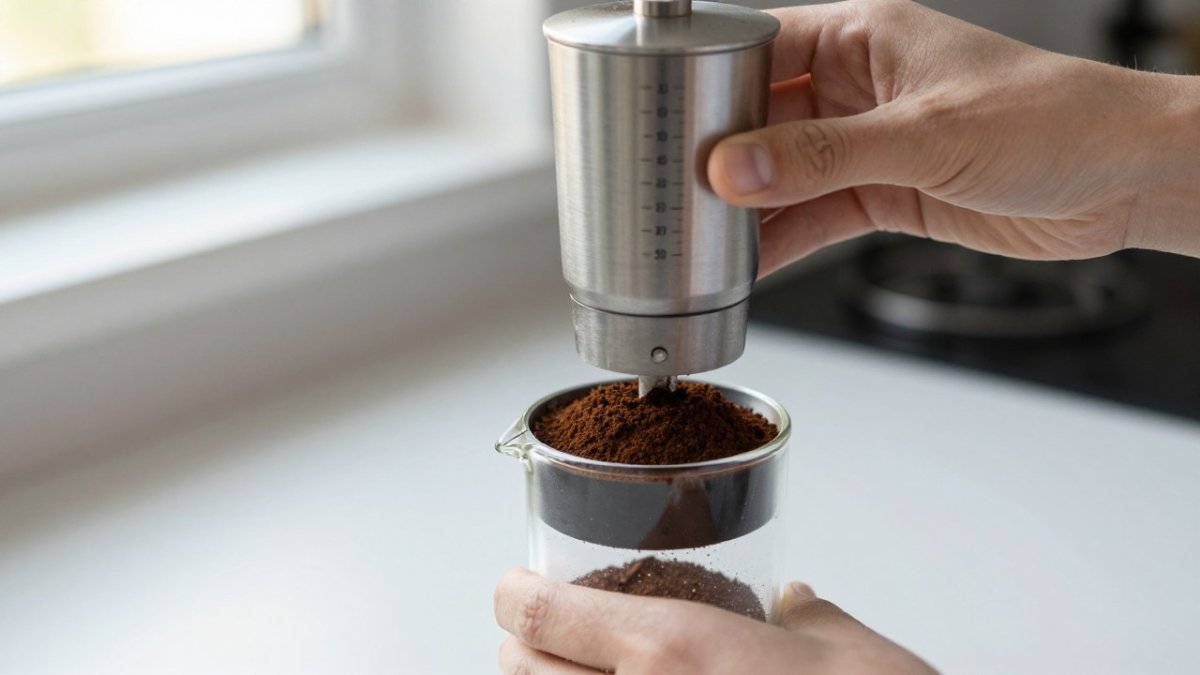
The reason grind matters so much comes down to extraction. Water dissolves flavor compounds from the surface of each coffee particle inward. Fine particles give up their flavor quickly; coarse particles give it up slowly. If your grind is uneven, some particles over-extract (releasing bitter, harsh compounds) while others under-extract (leaving sour, thin flavors) in the same cup.
Match grind size to your brewer
Use this as a starting point, then adjust by taste:
- French press and cold brew: coarse, roughly the texture of sea salt or raw sugar, with visible individual fragments.
- Drip coffee maker: medium, like table salt, with particles that feel slightly gritty between your fingers.
- Pour-over (cone dripper): medium-fine, closer to fine sand, so water passes through in roughly 2:30 to 3:30 minutes.
- AeroPress: medium-fine to fine, depending on steep time; finer grinds need shorter steeps.
- Espresso-style brewing: fine, like powdered sugar, with a texture that clumps slightly when pinched.
A common pattern is that home brewers start too coarse. If your drip coffee tastes weak and watery even at a strong ratio, the grind is often the culprit, not the dose.
Burr vs. blade: what actually matters
A burr grinder gives even particles, which means more consistent flavor and repeatable results when you change one variable at a time. If you are shopping for one, see our picks for affordable manual grinders for beginners. A blade grinder chops unevenly, so some grounds over-extract while others stay weak, and the same setting produces a different result every morning.
Watch out: blade grinders heat the beans as they chop, and the friction can drive off aromatics before you ever brew. If a blade grinder is all you have, pulse in short bursts and shake the grinder between pulses to even out the particles.
Adjust grind before you adjust anything else
When a cup tastes wrong, grind is usually the first variable to test because it changes extraction speed without changing your routine. If the cup is sour or thin, grind finer in small steps. If it is bitter or harsh, grind coarser.
Keep your grinder clean. Oils from roasted coffee coat the burrs and rancidify over time, which adds a stale, cardboard-like note to every cup. Brush the burrs weekly and run a small amount of uncooked white rice through a blade grinder (never a burr grinder, which can be damaged) or use a dedicated grinder cleaning tablet according to the manufacturer's instructions.
[IMAGE_PLACEHOLDER]
Coffee-to-Water Ratio for Brewing and How to Measure It
A common starting point is a 1:16 ratio: 1 gram of coffee for every 16 grams of water. For a 16-ounce mug, that works out to about 30 grams of coffee and 480 grams of water.
Use a kitchen scale instead of scoops. Scoops vary a lot by grind size, so weighing gives you repeatable results. Write down what you used, then adjust one thing at a time until the cup tastes right to you.
Water Temperature, Brew Time and Troubleshooting by Taste
Water temperature and brew time are the two variables that decide how much flavor ends up in your cup, and most home brewing advice glosses over them. A widely used guideline puts the ideal water temperature for drip and pour-over brewing in the range of 195°F to 205°F (about 90.5°C to 96°C). Below that range, water under-extracts and the cup tastes sour and thin; above it, over-extraction brings out bitter, harsh, and sometimes ashy notes.
You do not need a thermometer to get close. Bring filtered water to a boil, then let it sit for about 30 to 45 seconds before pouring. That rest brings the water into the target range for most brewers. If you want repeatability, an inexpensive instant-read thermometer or a kettle with a built-in temperature setting removes the guesswork.
Brew time targets by method
Brew time is the other half of the extraction equation. These ranges are common starting points:
- Pour-over (single cone): 2:30 to 3:30 total, including a 30- to 45-second bloom.
- French press: 4 minutes steep, then press slowly and pour immediately.
- AeroPress: 1:00 to 2:00 steep depending on grind, then press for about 20 to 30 seconds.
- Drip coffee maker: 4 to 6 minutes for a full batch; if a small batch finishes in under 3 minutes, the grind is likely too coarse.
- Cold brew: 12 to 18 hours in the refrigerator.
If your brewer finishes faster than the low end of the range, grind finer. If it stalls or takes much longer, grind coarser. Time and grind are two dials on the same machine.
Troubleshooting by taste
Taste is the most reliable diagnostic tool you have. Use this guide to correct a cup, changing only one variable at a time so you know what worked:
- Sour, sharp, or thin: The coffee is under-extracted. Grind finer, raise the water temperature toward 205°F, or extend the brew time. If the cup is sour and also weak, increase the dose before changing anything else.
- Bitter, harsh, or drying: The coffee is over-extracted. Grind coarser, lower the water temperature toward 195°F, or shorten the brew time. Bitterness that lingers on the back of the tongue is a classic sign of too-fine a grind.
- Weak or flat but not sour: Increase the coffee dose or reduce the water. A 1:16 ratio is a starting point, not a rule; many brewers prefer 1:15 for drip and 1:17 for pour-over.
- Muddy or silty: Fine particles are passing through the filter. Grind coarser, use a finer filter, or let the brewed coffee settle for a minute before pouring.
- Inconsistent from cup to cup: The problem is usually uneven grind or an unstable pouring technique. Level the coffee bed before brewing and pour in slow, steady circles.
Watch out: changing two variables at once (say, grinding finer and adding more coffee) makes it impossible to know which change fixed the cup, and you may overshoot into bitterness. Write down each change and the result.
A note on water quality
Temperature and time only work if the water itself tastes good. Chlorine, hardness, and scale all carry through to the cup. If your tap water smells of chlorine or leaves white deposits on the kettle, brew with filtered water. A simple carbon filter pitcher is enough for most homes; you do not need bottled water, and distilled water actually brews flat coffee because it lacks the minerals that help extract flavor.
Use these starting points for brew time by method, and adjust the grind to hit the target.
| Method | Brew time | Adjust if |
|---|---|---|
| Pour-over (single cone) | 2:30 to 3:30, incl. 30-45 s bloom | Finishes under range: grind finer |
| French press | 4 minutes steep | Press slowly, pour immediately |
| AeroPress | 1:00 to 2:00 steep, press 20-30 s | Depends on grind |
| Drip coffee maker | 4 to 6 minutes | Under 3 minutes: grind too coarse |
| Cold brew | 12 to 18 hours, refrigerated | Adjust by steep length |
Keep Your Setup Clean and Brew Your First Cup This Week
Old coffee oils build up in grinders, carafes and filters, and they make fresh coffee taste stale. Rinse your gear after each use, and deep clean it weekly with warm water and a mild cleaner.
Start this week with one method, fresh beans and a scale. Brew a cup, taste it, and make one small change tomorrow. Within a few days, you will know exactly how you like your coffee. For current products and pricing, visit laffogatocoffee.com.
Frequently Asked Questions
What is the 1:16 coffee-to-water ratio?
The 1:16 ratio means one gram of coffee for every 16 grams of water, a common starting point for most home brewing methods. It is a practical baseline for measuring. Weigh your coffee and water on a kitchen scale for consistency. For a 12-ounce mug, that works out to roughly 20 grams of coffee and 320 grams of water. Once you have a cup you like, adjust the ratio a little stronger or weaker to suit your taste.
How do you make good coffee at home without a machine?
A French press, pour-over cone or AeroPress can all produce good coffee without an electric machine. Start with fresh beans, grind them just before brewing, and use the 1:16 ratio as your baseline. Heat water to roughly 200 degrees Fahrenheit, let the coffee steep or drip for several minutes, and taste as you go. Simple manual methods give you control over each variable, which makes them a good way to learn what you like.
What is the easiest way to brew coffee at home?
An automatic drip coffee maker is the easiest option because it handles timing and water temperature for you. Auto-drip favors convenience, while pour-over or French press may suit someone with more time to spare. If you are new to brewing, pick the method that fits your daily routine, then refine your grind and ratio over time to improve the cup.
How much coffee should I use per cup?
A common starting point is about 1 gram of coffee for every 16 grams of water, which is close to two tablespoons of ground coffee for a standard 6-ounce cup. Weighing your coffee gives more consistent results than measuring by scoop, since bean density and grind size change the volume. Adjust in small steps, and keep notes on what you change so you can repeat a cup you enjoy.